
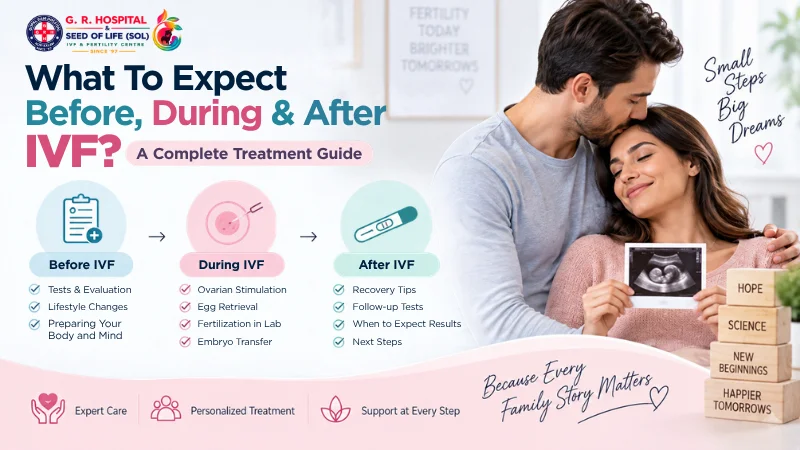
What To Expect Before, During & After IVF? A Complete Treatment Guide
IVF therapy is a huge step to take. For many couples it occurs after months or years of attempting to conceive, fertility studies or other therapies. It is absolutely normal to ask what occurs next: What tests are needed? What occurs in an IVF cycle? How do you collect eggs? What happens to the embryos ? What to expect after embryo transfer?
Knowing what the IVF process involves you can make the journey seem less alien and assist you to prepare for each stage.
In vitro fertilization (IVF) is an assisted reproductive procedure in which an egg and sperm are joined in a laboratory to form an embryo. The embryo is subsequently placed in the uterus to become pregnant.
The precise plan for treatment depends on the individual and the relationship. But most IVF journeys have a few important moments. At GR Hospital, known as the Best IVF Centre in Mathura , couples looking for an IVF Centre in Mathura or an IVF Centre Mathura residents can reach easily are guided through each of these moments by one fertility team.
What is the procedure before IVF?
Before initiating an IVF cycle, your fertility specialist will analyze your reproductive health and attempt to identify the potential cause of infertility.
The purpose is to work out whether IVF is appropriate and to create a treatment plan that is tailored to your individual circumstances. Couples visiting our IVF Centre in Kosi Kalan, which many families regard as the Best IVF Centre in Kosi, the Best IVF Centre in Brij and a trusted IVF Centre Brij Dham, receive a plan built around their own test results.
1. Fertility Consult
Your fertility specialist will often start with a thorough consultation.
Your doctor may talk about:
- Your fertility and medical history
- Past pregnancies
- Past fertility treatments
- Ovulation and menstrual cycle
- Previous surgery
- Pre-existing medical conditions
- Drugs and supplements
- Goals for fertility
Both partners may be checked because reproduction problems may include one or both partners.
2. Fertility Testing Before IVF
Your fertility specialist may recommend additional testing before therapy.
They may include:
Testing of ovarian reserve
Tests such as AMH (anti-Müllerian hormone) and antral follicle count can be used to measure ovarian reserve and help plan ovarian stimulation.
Ultrasound
A transvaginal ultrasound can provide information about the uterus and ovaries and can detect problems such as fibroids or ovarian cysts. If a fibroid or cyst needs treatment before IVF, our Laparoscopic Gynae Mathura team can assess it, with the same Laparoscopic Gynae Kosi and Laparoscopic Gynae Brij Dham care offered at our Kosi Kalan hospital.
Hormone Testing
Blood tests may be recommended to check reproductive hormones and other factors that may affect treatment.
Sperm Analysis
A semen analysis looks at many parts of sperm health such as the amount of sperm, how well it moves and its shape.
Uterus Evaluation
Depending on your medical history, your doctor may recommend extra tests on the uterus before the embryo transfer. Where a uterine problem needs correcting first, patients seeking Gynecological Surgery Mathura , Gynecological Surgery Kosi or Gynecological Surgery Brij Dham can be treated by our gynecology team.
Not all tests are necessary for every patient. Your fertility specialist will decide which investigations are right for you. If tests show blocked tubes or endometriosis, women needing Laparoscopic Surgery Mathura , Laparoscopic Surgery Kosi or Laparoscopic Surgery Brij Dham can have keyhole treatment at GR Hospital before the IVF cycle begins.
3. Getting Your Body Ready for IVF
Once your fertility team has set up your treatment plan, they may offer guidance on preparation for the IVF cycle.
Healthy habits can enhance your general wellbeing during therapy.
You may be recommended to:
- Eat a balanced meal
- Keep a healthy weight
- Avoid smoking cigarettes.
- Limit or avoid alcohol
- Limit caffeine intake
- Get enough physical activity
- Review medications with doctor
- Take vitamins as prescribed if advised
Do not make any big changes in prescription drugs without consulting your doctor.
How does IVF work?
An IVF cycle consists of a number of steps and the specific protocol will be dependent on your age, ovarian reserve, reproductive history and other factors.
Step 1: Ovary Stimulation
Stage 1 is normally ovarian stimulation.
Fertility medicines stimulate the ovaries to create several follicles instead of the one follicle that may arise in a natural menstrual cycle.
Your fertility experts will check your reaction with ultrasound scans and blood testing, if needed.
Your medication dose may be changed depending on how your ovaries respond.
2. Trigger Injection
Once the follicles are mature enough, your doctor may recommend a trigger injection to help the eggs complete the last phase of maturation.
The timing of this injection is critical as egg retrieval is scheduled at a set time after.
Your fertility clinic will provide you detailed advice on when to take the injection.
Step 3: Egg Pick Up
Egg retrieval, or egg collection, is the method used to collect mature eggs from the ovaries.
It is often done under ultrasound supervision and most patients will be sedated or anesthetized.
A tiny needle is passed through the vaginal wall to the ovaries to retrieve fluid containing the eggs from the follicles.
The eggs recovered are transported to the laboratory for evaluation.
Step 4: Harvesting and Processing Sperm
Usually a sample of sperm is provided at the time of egg retrieval.
The laboratory team prepares the sample and selects sperm for fertilization.
Sometimes sperm has to be retrieved through a medical treatment or frozen sperm has to be used.
Step 5: Fertilization
In the laboratory, the eggs and sperm are collected and mixed.
Depending on the reproductive issue, traditional IVF or intracytoplasmic sperm injection (ICSI) may be performed.
ICSI is where a single sperm is put directly into an egg to help in fertilization.
The fertilized eggs are then watched as they grow into embryos.
Step 6: Embryogenesis
The embryos are observed in the laboratory after fertilization.
Embryology team – Monitors the development of the embryos and analyzes the embryos according to the clinic’s protocols.
Depending on the treatment strategy, embryo transfer may be performed at an appropriate stage of development or acceptable embryos may be preserved for future use.
Your fertility doctor will discuss the approach that is recommended for you.
Step 7: Transferring the embryos
Embryo transfer is the point when the chosen embryo is transferred into the uterus.
Normally a tiny catheter is inserted through the cervix and used to put the embryo into the uterus.
Embryo transfer is normally a pretty simple operation and usually does not require anesthesia.
How many embryos you have transplanted will depend on your specific circumstances and your fertility team's guidance.
What are the chances of IVF success?
The time after the embryo transfer can be an emotional time, as there is often a waiting period before a pregnancy can be verified.
1. The Wait
After embryo transfer you may continue taking drugs such as progesterone (if advised by your fertility specialist)
Usually you can do your normal everyday activities unless your doctor tells you not to.
It is vital not to read every bodily sensation as a sign of pregnancy. Symptoms may be due to drugs or normal hormonal changes as well as early pregnancy.
2. Pregnancy Test
Your fertility clinic will provide you with the information about when to take a pregnancy test.
Testing too early can result in an inaccurate reading, especially if fertility drugs have affected hormone levels.
Follow your fertility team’s testing date.
If your test is positive, your clinic will do further blood tests and an ultrasound when necessary, to confirm and monitor the pregnancy.
What If IVF Doesn’t Work?
IVF does not guaranty a pregnancy.
If you don’t get pregnant after an IVF cycle, your fertility specialist can analyze the cycle and discuss what happened.
The doctor may consider, depending on your circumstances:
- Development of the embryo
- Ovarian response
- Results of fertilization
- Uterine considerations
- Sperm factors
- History of previous therapy
The next step could be another IVF round, a different treatment technique or more inquiry.
One failure round doesn’t guarantee that IVF will not succeed in the future.
How Long Does the IVF Process Take?
How long does an IVF cycle take? The length of an IVF cycle can vary from person to person.
This can include several weeks of preparation, ovarian stimulation, monitoring, egg harvesting, embryo development and embryo transfer.
Some individuals may have further prep prior to starting stimulation and others may undergo frozen embryo transfer in a subsequent round.
Your fertility clinic will be able to provide you a more realistic time frame based on your particular treatment plan.
What to avoid during IVF?
Your fertility doctor will provide you with personalized guidance, but some broad things to consider may be:
- Smoking
- Too much alcohol
- Medications or supplements you don’t need
- Vigorous Exercise
- Crash dieting
- Changing meds without doctor's guidance
Ovarian stimulation can cause your ovaries to become larger and your doctor may advise that you limit certain physical activity.
Be sure to follow the exact directions from your fertility team.
Questions you should ask your fertility specialist
Before commencing IVF it can be good to ask:
- Why do I need IVF?
- What tests do I need before treatment?
- Which IVF protocol will I follow?
- How many monitoring appointments do I need?
- What medicines will I take?
- What happens when they retrieve your eggs?
- Will I need to have ICSI?
- How will the embryos be tracked?
- When will the embryo transfer be done?
- What are my odds of success?
- What might go wrong?
- Does the cycle fail what happens?
Having clear answers might help you go into treatment with realistic expectations.
Each person’s IVF journey is unique.
IVF is a process with several carefully planned steps starting from the initial fertility consultation and ending with the pregnancy test. You may be assessed for fertility, get a medical examination and prepare your lifestyle before IVF. The IVF process normally involves ovarian stimulation, egg retrieval, fertilization, embryo development and embryo transfer. After IVF you enter the waiting phase before pregnancy testing and follow-up.
It can seem like a complicated process at first, but your fertility experts will help you through each step.
Most importantly, remember that IVF is a personalized treatment. Your age, reproductive health, fertility history, ovarian reserve, sperm health and previous treatment outcomes can all impact the treatment approach.
If you’re considering IVF, speak to a knowledgeable fertility doctor who can explain the process, explore your options and help you understand what to expect at each step of your treatment journey.
Frequently Asked Questions
How long does one IVF cycle take?
Including preparation, ovarian stimulation, monitoring, egg retrieval, embryo development and transfer, one cycle usually takes several weeks. Your fertility clinic will give you a timeline based on your own treatment plan.
Is egg retrieval painful?
Egg retrieval is usually done under sedation or anesthesia, so most patients do not feel pain during the procedure. Mild cramping or discomfort afterwards is common and usually settles quickly.
What is the difference between IVF and ICSI?
In conventional IVF, eggs and sperm are mixed in the lab so fertilization can happen naturally. In ICSI, a single sperm is injected directly into each egg, which is often used for male-factor infertility.
Do I need bed rest after embryo transfer?
Usually not. Most women can return to normal daily activities after embryo transfer unless their doctor advises otherwise. Continue any prescribed medicines, such as progesterone, as directed.
When should I take a pregnancy test after IVF?
Take the test on the date your fertility clinic gives you. Testing too early can give a misleading result because fertility medicines can affect hormone levels.
What happens if my first IVF cycle does not work?
Your fertility specialist will review the cycle, including ovarian response, fertilization and embryo development, then discuss next steps. This may be another cycle, a changed protocol or further tests.